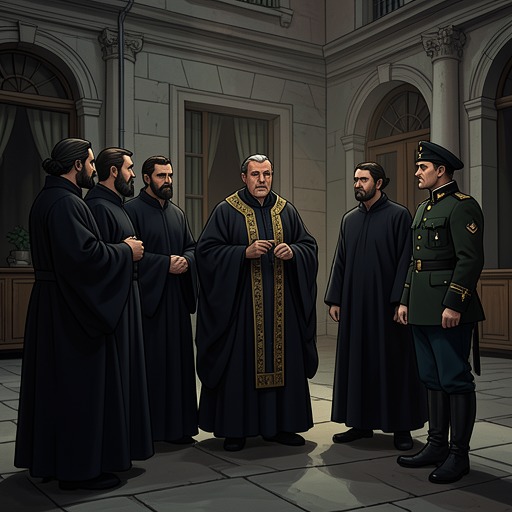
Emperor Xian
The Romance of the Three KingdomsEmperor Xian, also known as Liu Xie and earlier as Prince Xie, is the Han ruler whose authority survives even as control of the court passes from one powerful faction to another. His reign gives competing leaders a source of political legitimacy: Dong Zhuo uses the imperial succession to establish a new ruler, Cao Cao later controls the emperor, and Cao Pi eventually secures the throne through Xian’s abdication. The loss of the throne does not close the question of the Han’s legitimacy; instead, it becomes the reason Xuande claims that the dynasty must continue through him.
Identity and Rise to the Throne
As Prince Xie, Xian appears during the disorder surrounding the palace. After he and his elder brother escape the chaos, a farmhouse master finds them and shelters them. When the boys are discovered, Xie identifies himself as the emperor’s younger brother and explains that they fled the palace and the eunuchs. His composure stands out: when Dong Zhuo’s army confronts the returning party and the emperor is too frightened to speak, Xie rides forward, asks Dong Zhuo who he is, and demands that he dismount and show the emperor proper respect.
Dong Zhuo is impressed by the prince’s calm in contrast to the emperor’s fear. Once Xian is reunited with Empress He, the immediate crisis appears to have passed. But Dong Zhuo has already begun planning to depose the reigning emperor and install Xie. At a feast before the nobles, he argues that the emperor lacks the gravitas required of the Son of Heaven, whereas Xie possesses it, and proposes replacing him. Ding Yuan alone objects openly. The episode makes Xian’s elevation inseparable from the coercive political world around him: his fitness to rule is publicly invoked, but the decision is driven by Dong Zhuo’s power.
A Ruler Without Secure Power
The narrative presents Xian’s imperial status as valuable to men who can command armies but cannot claim the throne by themselves. Later, after Wang Yun’s campaign against Dong Zhuo ends in turmoil, Xian appears on the palace wall as the rebels demand Wang Yun. Wang Yun tells the emperor that his actions were intended to protect the throne, accepts responsibility for the resulting disorder, and gives himself up to the rebel leaders. Xian cannot halt events by virtue of his office; the episode places the emperor in the position of witness to a struggle conducted by armed factions.
When Xian returns to Luoyang, he finds a capital whose palaces have been burned and whose people face famine. Yang Biao proposes summoning Cao Cao to protect him, and Xian consents. Cao Cao arrives as Li Jue and Guo Si threaten the city; his troops defeat them, and the emperor returns to the palace. The rescue strengthens Cao Cao’s position rather than restoring the emperor’s independence. Dong Zhao then advises Cao Cao to move the court to Xuchang, where Cao Cao can control it more completely and sideline rival commanders. In the political arrangement that follows, the emperor’s presence lends authority to the regime, while the power to act belongs increasingly to the man protecting him.
The Han Claim and Xuande
The struggle over Xian’s authority becomes explicit in Kong Ming’s counsel to Xuande. Kong Ming describes Cao Cao as powerful not only because he has overcome Yuan Shao by cunning and commands a vast army, but because he controls the Son of Heaven and thereby draws the allegiance of many nobles. In this account, possession of the emperor is an instrument of political advantage. The imperial title remains consequential even when the emperor himself cannot freely exercise it.
After Xuande’s forces gain ground in the regions around Hanzhong, his commanders urge him to become emperor. Kong Ming argues that Cao Cao has usurped the true ruler’s authority and that Xuande, known for benevolence and in control of Shu, should accept the throne to restore rightful rule. Xuande objects that, despite his Han ancestry, accepting the title could make him appear a rebel. Kong Ming counters that the empire has been seized by adventurers and that people long for a true emperor. Xian’s position therefore creates a continuing dispute about what loyalty to the Han requires: whether legitimacy rests in the current emperor’s person, or whether a descendant of the Liu house must act when the emperor has been deprived of power.
Abdication and the Transfer of Legitimacy
Cao Pi’s accession turns that dispute into a formal transfer of the throne. Hua Xin presents the court’s demand that Xian follow the precedent of Yao and Shun and hand the empire to the king of Wei, claiming that the Han dynasty has run its course. Xian recalls that the Liu family has held the throne for four hundred years and asks what wrong he has committed to deserve surrendering what came to him from his ancestors. Astrologers then cite auspicious signs as evidence that Heaven has transferred the mandate to Wei. Wang Lang reinforces the demand by arguing that every dynasty and ruling family eventually ends; Xian responds by leaving rather than agreeing.
The pressure resumes the next day. Xian initially refuses to come to the Formal Hall, and his empress supports his resistance, but her uncle eventually persuades him to attend. There Hua Xin again warns of consequences if he does not comply. Xian protests that the officials have prospered through service to the Han and asks how the descendants of loyal servants can contemplate the transfer. Surrounded by officials and soldiers, he finally declares that he will surrender the throne to Cao Pi and asks to live out the remaining years Heaven has allotted him. The abdication announcement, written in his name, presents the change as a response to Heaven’s signs and the people’s will, and compares the transfer to the ancient precedent of Yao. Its language of voluntary succession stands against the pressure that has brought Xian to this point.
Sima Yi advises Cao Pi to delay accepting, so the transition proceeds through repeated refusals and appeals before an Altar of Abdication is built. At the ceremony, Xian hands over the jade seal of authority before officials and soldiers, and Cao Pi accepts the throne as emperor of Wei. Xian is then demoted to governor of Shanyang and ordered to leave. The formal ritual gives the new dynasty an appearance of orderly succession, but the surrounding events show how little freedom remained to the former emperor. The narrative further associates Cao Pi’s accession with an omen: a storm breaks out during his worship of Heaven and Earth, and he collapses, an episode presented as a sign of Heaven’s displeasure.
Political and Narrative Significance
Xian’s story is shaped by the gap between imperial status and effective power. He can be the object of rescue, protection, transfer, and political argument, while decisions are made by the commanders and advisers who control the court. His early insistence that Dong Zhuo show respect to the emperor briefly makes the rules of imperial protocol visible; his later helplessness reveals how readily those rules are overridden by force.
His abdication ends the Han dynasty in the succession accepted by Cao Pi, but it does not settle the novel’s argument over legitimate rule. News of Wei’s establishment reaches Chengdu, and rumors that the former emperor has been killed distress Xuande. Kong Ming proposes that Xuande be crowned as the new Han emperor, presenting his descent from the founder of the Han as a basis for continuing the lineage. Thus Xian’s surrender of the seal is both an ending and a political opening: the throne passes to Wei, while the claim to represent the Han remains available to Xuande.